Who Did the Sign Program at the Museum of Fine Arts Boston
When the pandemic acquired borders to shut, travel restrictions to rise, and venues to close, open, and and then close again, it left a lot of folks stranded in places far from their homes. That included a group of guys with last names like Van Gogh, Renoir, Monet, Degas, Cézanne and Pissarro.
Well, at to the lowest degree the works of those artists and others who cut their teeth (and brushes) during the heyday of French Impressionism in the belatedly 19th century. And after a COVID-delayed and truncated showing at the National Gallery of Victoria in Melbourne, Commonwealth of australia this summer, some 90 paintings and 15 prints were on their way back to their permanent home at the Museum of Fine Arts, Boston.
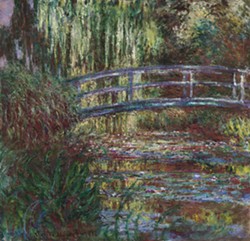
"The Water Lily Pond" by Claude Monet, 1900.
© Museum of Fine Arts, Boston All Rights Reserved
Only through some Curatorial Black Magic and the silver-tongued workings (and fundraising) of Museum of Fine Art, Houston Director Gary Tinterow, the exhibit Unequalled Impressionism from the Museum of Fine Arts, Boston has landed here and will be on view through March 27. It is the only U.S. cease for the collection.
"It was a wonderful arrangement that happened at a curious moment. He'd seen the catalog and knew the works from his time as a graduate educatee at Harvard," says Helga Aurisch, MFAH Curator of European Fine art. "And information technology was sequestered in Australia. But he was able to talk to his friend in Boston, and this exquisite show will go to exist seen by more people now."
Today, of course, the French Impressionists are the Rock Stars of Painting. Their names familiar to fifty-fifty the general populace, and their most famous works found on everything from T-shirts and tote bags to prints and men's ties (not to mention the two competing Immersive Van Gogh Experiences currently running in Houston).
But it wasn't ever that style. In fact, these artists were considered radicals when they first began working in the 1860s. And as Aurisch explains, had to create their own opportunities after being soundly rejected by status quo of the fine art world.
"They were actually the rebels and struck out on their ain when they had a difficult time getting their works accepted past the Salon, which was the official juried evidence. And all the jurors were professors at the art schools in Paris. And they rejected this manner, which was very contrary to their ain bookish style," Aurisch continues.
"The Impressionists' work looked like sketches to them. Like they were unfinished and rough. So, these new artists grouped together and arranged their own exhibits, which they did in the spring of 1874. But at the time they didn't telephone call themselves Impressionists. They were independent artists. They drew less people, and the printing hated them. So, they struggled for years earlier finding some acceptance in the 1880s."
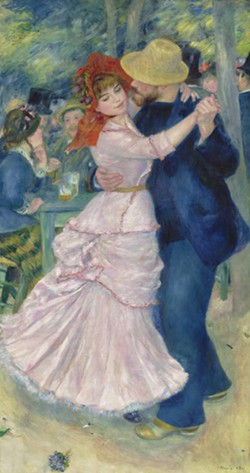
"Trip the light fantastic at Bougival" past Pierre-Auguste Renoir, 1883,
© Museum of Fine Arts, Boston/All Rights Reserved
Of all the artists whose works are on display in Incomparable Impressionism, there are more works by Claude Monet (1840-1926) than whatsoever other. Coming in next would-be Pierre Auguste-Renoir (1841-1919). The pair were "fast friends" according to Aurisch, fifty-fifty if their styles and subject affair were often unlike.
Equally the exhibit's itemize points out, Renoir was more than of an extrovert who concentrated on paintings of people and craved interaction ("I suffer from the illness of experimentation," he once famously said). Monet, by comparison, liked to work solitary and focused on landscapes and his famous depictions of bodies of water.
Aurisch relays a story in which the two friends decided to set their easels side-by-side to capture the scene of bathers by the Sienne River at a place only outside of Paris. "They painted the same scene, and it's very interesting. Monet concentrates on the landscape just has a few figures. And Renoir paints the figures in particular, with some mural. They each had [specialties], and Monet didn't become a pure landscapist until the late 1870s."
She adds that Monet'south development every bit a painter is "cleaner" and shows more of a linear trajectory, while Renoir would often work in one way with subject thing and style, reject it, so move on to something dissimilar. "Renoir was the portraitist of the Impressionists. And he particularly liked painting beautiful young women. It was his please," Aurisch adds.
And indeed, the showroom contains a balance of portraits, landscapes, still lifes, architecture and works in which the artists utilized models. Probably the most famous painting of them all is Renoir's Trip the light fantastic toe at Bougival. The familiar image shows couple dancing in an outdoor setting with much of the bearded human being's face hidden past a rakishly tilted yellow hat, and his partner in a lush pinkish dress and red bonnet with eyes closed, grinning in contentment.
Aurisch drops the knowledge bomb that while Renoir's male model is lost to history, the woman in this "monumental, realistic and lovely" work is most likely Suzanne Valadon, who worked as a model for several painters at the time, and later became one herself (the MFAH has one of her self-portraits in their collection, pregnant she appears on brandish twice). It's likewise one of a series of three Renoir paintings depicting couples dancing.
The catalog for the show too talks about the importance of mentors to the Impressionists, and in many cases how they outshone these teachers. As Monet did with his mentor, Eugène Boudin.
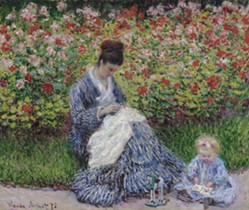
"Camille Monet and a Child in the Creative person's Garden in Argenteuil," by Claude Monet, 1875.
© Museum of Fine Arts, Boston/All Rights Reserved
And several in Pissarro'south tutelage included immature men whose minds and art he broadened (though in unlike means): Cézanne, Van Gogh and Gaugin. And so, does Aurisch know of any jealousies that resulted?
"That'due south a good question! I don't recall and then. Monet was incredibly grateful to Boudin and has said that he owes everything to him," she says. "He showed Monet how to paint outdoors. And then Boudin became influenced by Monet and Impressionism later on in his life. They had a back-and-forth influence," Aurisch says. "And all three of Pissarro'southward [students] revered him for their entire lives."
The catalog for the show also discusses how the advent of metallic tubes to store oil paint in fabricated the Impressionists much more mobile and able to work outdoors on their easels and canvasses. "The thought of putting paints into tubes was actually patented by an American in 1841, and that came from toothpaste!" Aurisch says.
"He thought it would be very helpful to all painters. Because in centuries past, yous had to grind your own paint and mix it and if you wanted to take it with you, you had to transport it in sheep'south bladders or something that'southward bound to rip and spill. It was a messy business! But by this time, the pigment tubes were available in artist's shops. Information technology had a huge impact."
She adds that it was especially benign to artists from the Barbizon School, of which there are many represented in Incomparable Impressionism. The grouping takes its name from the hamlet of Barbizon, France. It's on the border of the big Forest of Fontainbleau most 55 kilometers southeast of Paris and is seen in many of the works here.
Finally, when asked if Gary Tinterow, say, knocked on her office door and told he she could accept one painting from the exhibit domicile tonight, which one would she pick for her living room?
"Dream on!" she laughs heartily. "I would probably accept something by Monet. Either The H2o Lily Pond with the Japanese footbridge or Camille Monet and a Child in the Creative person's Garden in Argenteuil. It's the high point of Monet's High Impressionist style. The calorie-free is flickering and the subject so engaging. Just I tin merely have two?
Incomparable Impressionism from the Museum of Fine Arts, Boston runs through March 27, 2022, at the Museum of Fine Arts Houston in the Beck Galleries, 5601. For info, call 713-639-7300 or visit mfah.org/exhibitions. Tickets $22 and upwards.
Source: https://www.houstonpress.com/arts/things-to-do-see-incomparable-impressionism-at-the-museum-of-fine-arts-houston-12286543
0 Response to "Who Did the Sign Program at the Museum of Fine Arts Boston"
Post a Comment